

Wings of Desire English: A Poetic Exploration of Humanity in Cold War Berlin

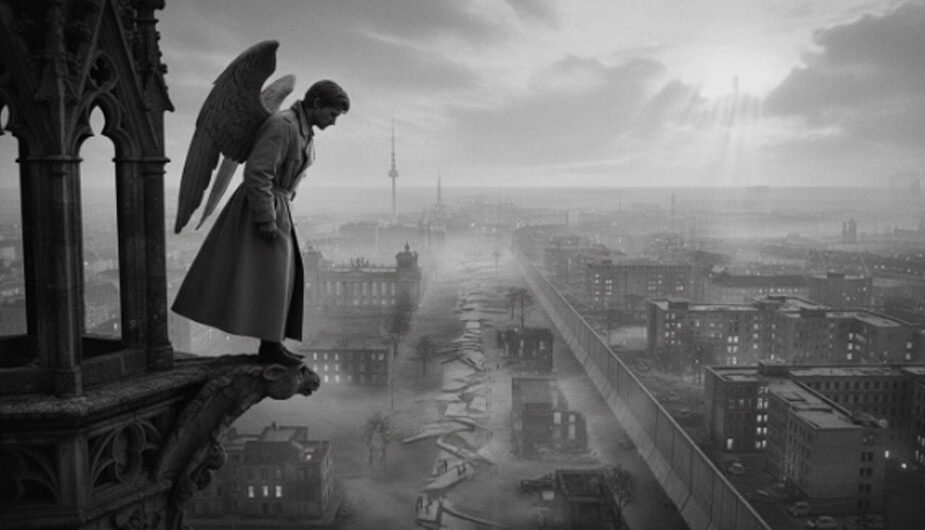
Is it possible to be surrounded by the beauty and chaos of human life and yet feel nothing at all? This profound question lies at the heart of Wings of Desire English, Wim Wenders’ 1987 cinematic masterpiece, originally titled Der Himmel über Berlin.
The film is not merely a story; it is a poetic meditation on existence, a haunting and beautiful exploration of what it means to trade eternal, detached observation for the messy, fleeting experience of being human. It invites the viewer to see the world through the eyes of an angel.
The Silent Watchers: Angels in a Divided City
The narrative centers on two angels, Damiel and Cassiel, who have silently watched over the city of Berlin since time immemorial. They are invisible to mortals, yet they can hear the innermost thoughts, fears, and joys of every person they encounter.
They are the city’s chroniclers, witnesses to history, and silent comforters to the lonely. Their existence is one of pure spirit, a constant, gentle presence that can offer solace but never intervention.
The Premise: Damiel and Cassiel
Damiel, played with quiet intensity by Bruno Ganz, is the angel who begins to yearn for more. He is tired of the endless, colorless existence of merely observing. He craves the tangible.
Cassiel, his companion, remains the stoic, philosophical observer, content with his role. Their contrast highlights the central conflict: the spiritual versus the sensual, the eternal versus the temporal.
The Setting: Cold War Berlin
The choice of Cold War Berlin is crucial. The city is physically and emotionally fractured, a landscape of ruins and reconstruction, hope and despair.
The angels’ perspective, often shot from high above, emphasizes this division, showing a city of isolated individuals yearning for connection across invisible and visible walls.
A Symphony of Sight and Sound: The Film’s Unique Aesthetic
Wenders employs a striking visual technique that is central to the film’s philosophical message. The world as seen by the angels is rendered in luminous, grainy black and white.
This monochrome palette suggests a world of pure thought and spirit, lacking the vibrant sensory input that defines human experience.
Black and White vs. Color: The Shift in Perspective
When Damiel decides to cross the threshold into humanity, the film bursts into color. This sudden, visceral shift is one of cinema’s most famous moments.
It signifies the overwhelming rush of sensory experience—the taste of coffee, the warmth of the sun, the sight of a red dress—that the angels had been denied.
The Power of Inner Monologue
The film is saturated with inner monologues, a constant stream of consciousness from the people of Berlin. We hear their worries about money, their fleeting crushes, and their deep-seated anxieties.
This technique immerses the viewer in the collective human condition, making the angels’ longing for connection all the more poignant.
The Desire for the Human Touch
Damiel’s desire crystallizes around one person: Marion, a lonely, beautiful trapeze artist who performs in a small circus. She is a symbol of human vulnerability and grace.
She represents the beauty of risk, the willingness to fall, and the resilience to get back up—qualities that are inherently human and utterly foreign to the angels.
Marion: The Trapeze Artist and the Catalyst
Marion is the catalyst for Damiel’s transformation. Her loneliness mirrors his own spiritual isolation, and her physical, grounded existence is everything he dreams of.
His love for her is not a romantic cliché but a profound yearning for shared experience, for a hand to hold and a voice to speak with.
The Sacrifice: Falling from Grace
Damiel’s decision to “fall” from grace and become mortal is a philosophical sacrifice. He trades immortality for a single, precious lifetime.
The moment he sheds his armor and experiences the world as a man—the pain, the cold, the simple act of bleeding—is the film’s emotional climax.
The Philosophical Heart: What It Means to Be Human
Ultimately, Wings of Desire is a profound meditation on the value of a finite life. It suggests that true meaning is found not in eternal observation but in momentary, tangible experience.
The film champions the small, mundane joys that we often overlook, reminding us that the greatest miracle is simply being present.
The Joy of the Mundane
Damiel’s first human acts—touching a stone, feeling the cold air, and most famously, drinking a cup of coffee—are celebrated with a sense of wonder.
These are the simple, sensory pleasures that define our existence and give weight to our fleeting time on Earth.
Time, Mortality, and the Present Moment
By embracing mortality, Damiel gains the ability to truly live in the present. The film argues that the knowledge of an end makes every moment infinitely more valuable.
It is a powerful statement that the human experience, with all its pain and joy, is a gift worth sacrificing eternity for.
FAQ
Q: Is *Wings of Desire* a German film?
A: Yes, Wings of Desire (original title: Der Himmel über Berlin) is a 1987 West German and French co-production, directed by Wim Wenders.
Q: Is there an English version of *Wings of Desire*?
A: The original film is primarily in German and French, but it is widely available with Wings of Desire English subtitles. There is also an American remake, City of Angels (1998), which is entirely in English.
Q: What is the main message of the film?
A: The main message is a celebration of the human experience, emphasizing the value of sensory perception, emotional connection, and the profound beauty found in the mundane aspects of a finite life.