

Christian Morgenstern Morgenstern: The German Poet Who Mastered Nonsense and Metaphysics

Could a single poet truly bridge the gap between the profound and the absurd, between spiritual seeking and pure literary nonsense? The life and work of Christian Morgenstern Morgenstern provide a resounding answer.
This German writer, whose name is synonymous with whimsical verse, left behind a legacy far richer and more complex than his most famous poems might suggest. He was a master of language who used humor to explore the deepest philosophical questions.
A Life of Travel and Literary Pursuit
Early Life and Influences
Christian Otto Josef Wolfgang Morgenstern was born in Munich on May 6, 1871, into a family steeped in the arts. His father was a landscape painter, setting an early stage for a life sensitive to beauty and expression.
However, his early years were marked by tragedy and a nomadic existence. The loss of his mother to tuberculosis when he was just ten years old deeply affected him, a disease he would later contract himself.
This early exposure to suffering, combined with a restless spirit, shaped his worldview, leading him to seek solace and meaning in both literature and philosophy.
The Struggle with Illness and the Search for Health
Morgenstern’s adult life became a constant, often vain, attempt to outrun the tuberculosis that plagued him. He spent much of his time traveling across Germany, Switzerland, and Italy, seeking sanatoriums and better climates.
These travels, though born of necessity, were not without their benefits. They allowed him to encounter many of the leading literary and philosophical minds of his era, broadening his intellectual horizons.
His marriage to Margareta Gosebruch von Liechtenstern in 1910 brought a measure of stability and companionship to his final years, but the disease ultimately claimed him on March 31, 1914, at the age of 42.
The Birth of Nonsense: Galgenlieder and Palmström
The Unique Style of Literary Nonsense
The work for which Christian Morgenstern is best remembered is his collection of humorous verses, the Galgenlieder (Gallows Songs), first published in 1905. These poems, heavily inspired by English literary nonsense, are a unique blend of linguistic playfulness and subtle satire.
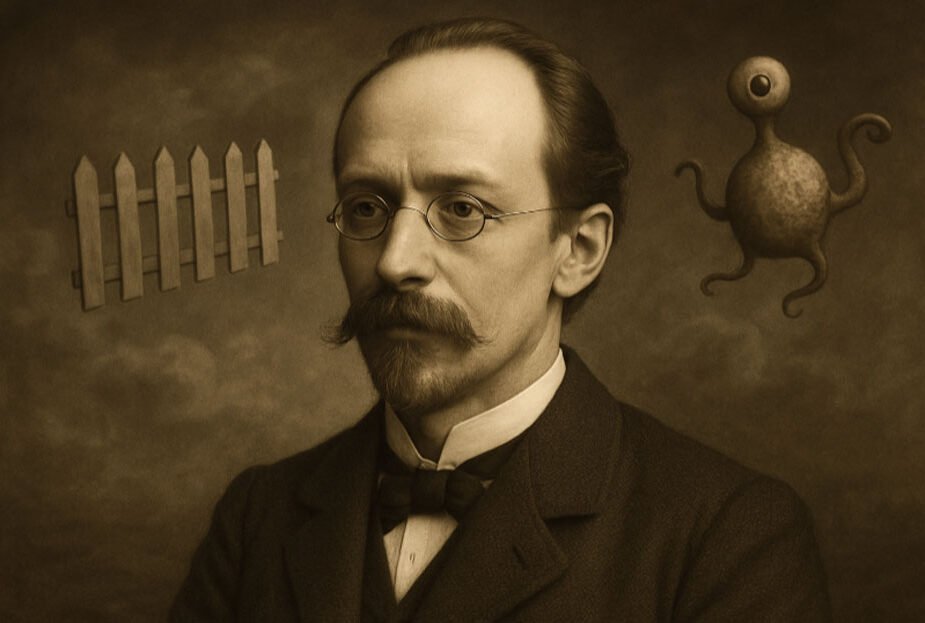
He delighted in mocking the rigidities of scholasticism, grammar, and narrow-mindedness. His verses feature bizarre characters and impossible scenarios, such as the famous “Picket Fence” (Der Lattenzaun) or the creature Das Nasobēm.
The enduring appeal of these poems lies in their ability to use absurdity as a lens for social commentary, questioning the very nature of reality and language itself.
The Enduring Popularity of the Gallows Songs
Despite enjoying very little commercial success during his lifetime, the Galgenlieder have become immensely popular in the German-speaking world. They have been reprinted countless times and are known by heart by generations of readers.
The collection was followed by Palmström in 1910, and later by posthumous volumes like Palma Kunkel and Der Gingganz. These works cemented Morgenstern’s reputation as a pioneer of modern German poetry.
One of his most quoted lines, from “The Impossible Fact” (Die unmögliche Tatsache), perfectly encapsulates his satirical wit:
Weil, so schließt er messerscharf / Nicht sein kann, was nicht sein darf. “For, he reasons pointedly / That which must not, can not be.”
Beyond the Whimsy: Morgenstern’s Serious Side
Philosophical Depth and Anthroposophy
To focus solely on the humorous side of Morgenstern Morgenstern is to miss a crucial dimension of his work. Alongside his nonsense verse, he wrote deeply lyrical and philosophical poetry, essays, and aphorisms.
His philosophical journey led him to the teachings of Rudolf Steiner, the founder of Anthroposophy. Morgenstern became a devoted member of the General Anthroposophical Society, and Steiner himself referred to the poet as “a true representative of Anthroposophy.”
This spiritual quest is evident in his more serious works, such as the posthumously published collection of aphorisms, Stufen (Stages), which contains profound reflections on life, the soul, and the search for meaning.
A Prolific Translator and Critic
Beyond his original poetry, Christian Morgenstern was also an acclaimed and prolific translator. He introduced German readers to the works of Scandinavian literary giants, including the dramas and poems of Henrik Ibsen, Knut Hamsun, and August Strindberg.
His critical writings, collected in Kritische Schriften, demonstrate a sharp intellect and a wide-ranging knowledge of European literature. He was an insightful critic who helped shape the literary landscape of his time.
The Legacy of a Lyrical Genius
Musical Settings and Lasting Influence
The lyrical quality and unique rhythm of Morgenstern’s poetry have made it a favorite among composers. His verses have been set to music by a diverse group of artists, from classical composers like Paul Hindemith and Alexander von Zemlinsky to contemporary musicians.
This continued engagement across different artistic mediums is a testament to the timeless and universal appeal of his words. His influence extends beyond literature, touching music, philosophy, and even mock-scientific endeavors, such as the fictional animal order Rhinogradentia, which was directly inspired by his poem Das Nasobēm.
The complete collected works of Christian Morgenstern Morgenstern, currently being published in nine volumes, ensure that future generations will continue to explore the full breadth of his genius, from the lighthearted to the deeply spiritual.
Frequently Asked Questions (FAQ) about Christian Morgenstern Morgenstern
Who was Christian Morgenstern?
Christian Morgenstern (1871–1914) was a German writer and poet, best known for his humorous and satirical literary nonsense, particularly the Galgenlieder (Gallows Songs). He was also a respected translator and a follower of the philosophical movement Anthroposophy.
What are the Galgenlieder?
The Galgenlieder (Gallows Songs) are Morgenstern’s most famous collection of poems. They are characterized by their playful use of language, absurd characters, and subtle philosophical or social satire, making them a cornerstone of German literary nonsense.
What was Morgenstern’s connection to Anthroposophy?
Morgenstern was deeply influenced by the Austrian philosopher Rudolf Steiner and became a member of the General Anthroposophical Society. His later, more serious works, such as his aphorisms, reflect the spiritual and philosophical principles of Anthroposophy.
Why is the name “Morgenstern Morgenstern” sometimes used?
While his full name was Christian Otto Josef Wolfgang Morgenstern, the repetition of the surname, as in Morgenstern Morgenstern, is sometimes used for emphasis or, in this context, for SEO purposes to capture a broader range of search queries related to his name.
How long did Christian Morgenstern live?
Christian Morgenstern lived for 42 years, from his birth on May 6, 1871, until his death from tuberculosis on March 31, 1914. Despite his short life, his literary output was substantial and highly influential.