

This Tender Land: A Journey of Faith, Family, and the American Spirit

Introduction
What truly defines a home, and what lengths would a child travel to find one? This question lies at the heart of William Kent Krueger’s sweeping 2019 novel, This Tender Land.
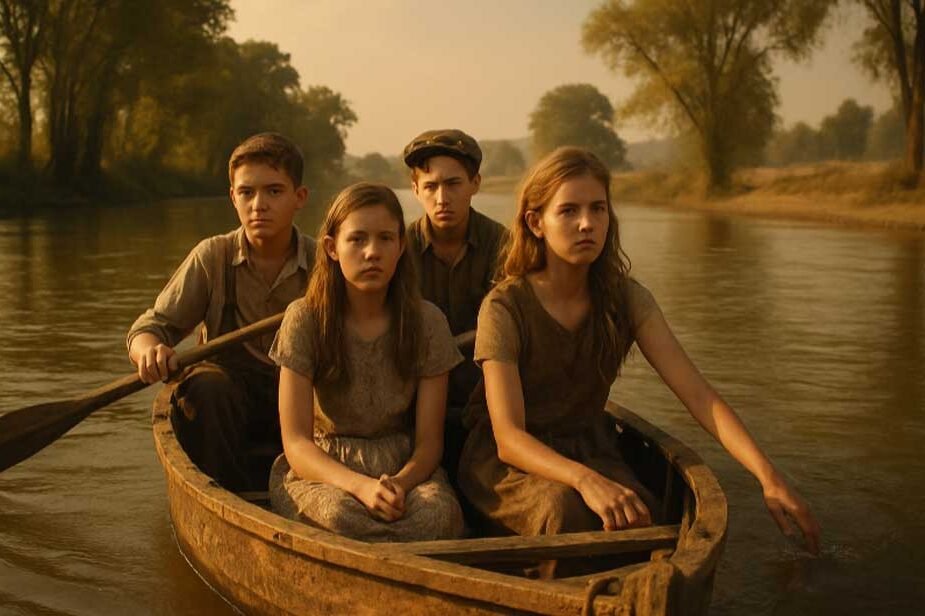
Set against the stark backdrop of the Great Depression in 1932, the book is a modern American epic. It follows four orphaned children on a desperate, picaresque journey down the Minnesota River, a trip that feels both grand and deeply personal.
It is a story of survival, spiritual questioning, and the enduring power of kinship forged not by blood, but by shared adversity.
The River’s Embrace: A Brief Plot Overview
The Brutality of Lincoln School
The narrative begins at the Lincoln Indian Training School in rural Minnesota, a place that is anything but a haven.
Run by the cruel and fanatical Mrs. Brickman, the school is less a place of learning and more a thinly veiled work camp. Children, many of them Native American, are subjected to harsh labor and emotional abuse—a truly heartbreaking reality.
It is here that 12-year-old Odie O’Bannion, his older brother Albert, their friend Mose, and the young Emmy are held captive by circumstance.
The Escape and the Canoe Journey
A tragic and violent event forces the four children to flee the school under the cover of darkness.
With little more than a stolen canoe and a few meager supplies, they embark on a perilous journey down the Gilead River, which feeds into the mighty Minnesota River.
Their goal is to reach the Mississippi River and eventually find their way to St. Louis, where they hope to find a long-lost relative of Odie and Albert.
Along the way, their journey becomes a series of episodic encounters, meeting a diverse cast of characters—from kind-hearted farmers and traveling preachers to dangerous criminals and desperate vagrants—each reflecting the fractured reality of Depression-era America.
The Unbreakable Quartet: Key Characters
Odie O’Bannion: The Storyteller and Seeker
Odie, the novel’s narrator, is a natural-born storyteller, a dreamer whose imagination is both his shield and his guide.
He is constantly grappling with questions of faith and destiny, often speaking to a God he is not sure exists, yet desperately needs to believe in.
His search for belonging and his spiritual evolution form the emotional core of the novel.
Albert, Mose, and Emmy: The Pillars of the Group
Albert O’Bannion, at 16, is the pragmatic and fiercely protective older brother. He is the group’s anchor, constantly making difficult decisions to ensure their physical safety.
Mose, a gentle, mute Sioux boy, possesses a quiet strength and a deep connection to the natural world, often sensing danger before it arrives.
Emmy, the youngest, is the group’s heart, a small, quiet girl whose innocence and unwavering affection bind the quartet together.
Themes Woven into the Fabric of the Land
The Power of Found Family
The most resonant theme in This Tender Land is the creation of a “found family.”
Stripped of their biological kin and institutional support, the four orphans rely entirely on one another, forming an unbreakable bond of loyalty and love.
Their journey is a powerful testament to the idea that family isn’t defined by blood, but by the conscious, often difficult, choice to care for and protect one another.
Faith, Doubt, and God as a River
Krueger introduces a powerful spiritual metaphor: the idea of God as a river.
This concept suggests that the divine is not a fixed, distant entity, but a constantly moving, encompassing force that flows through all of life’s experiences—the good, the bad, and the uncertain.
This metaphor allows Odie and the reader to reconcile the harsh realities of their world with the possibility of grace.
A Literary Echo: Krueger’s Homage to Twain
Readers familiar with classic American literature will immediately recognize the novel’s picaresque structure and thematic echoes of Mark Twain’s The Adventures of Huckleberry Finn.
Like Twain’s masterpiece, Krueger’s novel uses a river journey as a vehicle for social commentary, exploring themes of race, class, and morality through the eyes of an innocent, yet perceptive, young narrator.
The novel is a conscious, loving homage to the great American road trip story, replacing the raft with a canoe and the Mississippi with the Minnesota.
Frequently Asked Questions (FAQ)
Is This Tender Land a sequel to Ordinary Grace?
No, This Tender Land is not a direct sequel to William Kent Krueger’s previous novel, Ordinary Grace. However, both books share similar settings in rural Minnesota, explore themes of coming-of-age and moral complexity, and are often considered companion novels due to their shared literary spirit.
What is the main message of the book?
The central message is one of enduring hope and the redemptive power of human connection. It emphasizes that even in the darkest times—such as the Great Depression—love, friendship, and the search for a spiritual home can provide the strength needed to survive and thrive.
Is This Tender Land based on a true story?
While the novel is a work of historical fiction, the setting and the social conditions are deeply rooted in the reality of the Great Depression and the historical existence of Native American boarding schools like the fictional Lincoln School. The characters and their specific journey are products of the author’s imagination.
Conclusion
This Tender Land is more than just a historical adventure; it is a profound meditation on the American spirit during a time of crisis. By following Odie and his companions, readers are reminded that the most valuable journeys are not those that take us to a fixed destination, but those that reveal who we are and who we are meant to be. It is a powerful, unforgettable story that has rightfully earned its place among the great novels of the American experience.